


This is your Project Page. It's a great opportunity to help visitors understand the context and background of your latest work. Double click on the text box to start editing your content and make sure to add all the relevant details you want to share.
This is your Project Page. It's a great opportunity to help visitors understand the context and background of your latest work. Double click on the text box to start editing your content and make sure to add all the relevant details you want to share.
This is your Project Page. It's a great opportunity to help visitors understand the context and background of your latest work. Double click on the text box to start editing your content and make sure to add all the relevant details you want to share.
OXMAN
From Material to System
Following New Dawn, developed by Studio Simone van Es and designed by Aga Blonska, presented last year in the award-winning Last Supper installation, ROOTS continues to explore the future of materials—where design begins with biology and ends in regeneration.
At ROOTS Exhibition Milano, OXMAN presents 0°—a platform where material, technology, and biology converge. Built on the principle of one material, one biome, it rethinks how objects are made, used and returned to nature.
At its core is PHA, a biopolymer produced naturally by micro-organisms through fermentation. Unlike conventional plastics, PHA is fully biodegradable—designed to safely break down in soil and marine environments, returning to the ecosystem without leaving harmful residues.
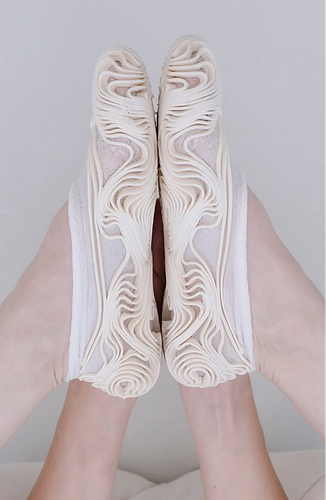
Within a compact robotic system, this material is directly 3D printed onto knitted PHA textiles, creating a seamless integration of fabrication processes. From printing to spinning and knitting, the material adapts across techniques—allowing design to evolve across stages, including its eventual decomposition.
In this system, waste is not an end point, but a phase. Design becomes part of a living cycle—programmable, responsive, and regenerative.
At ROOTS, 0° builds on this vision: a future where materials are grown, shaped, and returned— all within one continuous loop.